Thursday, January 2, 2014

Thoughts on Cycling


As a cyclist of many years I’ve decided to compile a list of things newcomers might take not of.  Some are obvious, some are preferences and some are purely my own prejudices.  Any other cyclists out there, feel free to disagree or to add your own thoughts.   I’ll add the ones I agree with to the list.

1.       Wear something bright or visible. 

The jury is out on what makes you visible in an urban setting.   All the different background colours on a busy shopping street make it difficult to stand out.  When I used to commute in London I always wore a day-glo workman’s vest (cheaper than specialist cycling shops).  The reflective strips are very effective in the dark.

Out in the countryside I wear a nice bright top or if I’m touring, strap my day-glo vest onto the back of my carrier.  Your Tour de France replica gear isn’t always going to do the trick.

2.       Lycra gear is for the Tour de France and elite cyclists.

Ok, a slight exaggeration.  A good pair of padded cycling lycras are a good investment if you intend spending more than an hour and a half in the saddle.   They’ll make life more comfortable if you’re riding off-road too.  If you’re going to spend many hours in the saddle, I’ve found gel padding more comfortable than foam.

 I once did the whole Argus Tour in a pair of joggers  - remember those polyester running shorts in the seventies?  My backside was fine. I was twelve and I managed it in five and a half hours, including a puncture repair.  So lycras don’t make you go faster, see?

Apart from making a fashion statement and spending a fortune, you’re not benefitting by wearing a branded cycling team shirt.  If your shirt says you’re an elite rider, your paunch vehemently contradicts it.  Technical fabric is good, especially for longer rides.  Though a normal t-shirt is adequate.  When I go touring I prefer a long-sleeved collared hiking shirt.  It’s light, cooler than a cycling shirt, dries quickly.  Best of all it keeps the sun off my arms and neck.

The point is this:  you can wear what you like to ride a bicycle – check out the Dutch. Don’t let the lycra brigade put you off cycling.


3.       Don’t ride in the gutter. 

Whether in the city or out in the countryside, take your space on the road.  I take at least a metre.  I’m of the opinion that you are more visible and command more respect from car drivers.  They are forced to change their line slightly and are less likely to push past you dangerously close.  If you have a bit of room on your inside you’ll have space to escape to without crashing onto the gravel if some idiot does try to brush past. 

On a related matter, keep an eye on the state of the road edge and the shoulder.  If, as happened to me in Namibia several times a day, an oncoming car overtakes and you have to duck off the road, you’ll know whether it’s an easy exit or you’re likely to crash!  You can plan accordingly.

4.       A bicycle is a vehicle.

Obey all the rules of the road.  That includes stopping at traffic lights.  If you don’t, you can’t demand the respect of motorists.  And signal when you’re turning, dammit!

5.       Don’t duck into bus stops and lay-byes.

 It may seem considerate to motorists but it then becomes difficult or even dangerous to re-enter the stream of traffic.  Claim your place on the road, you are as entitled to it as any other road user.

6.       Invest in the best lights you can afford. 

At dusk, dawn and at night, the better the lights the more visible you are.  Keep batteries fresh.  The number of cyclists I’ve seen riding with puny lights and/or nearly flat batteries is frightening.  A token light is as good as useless.

7.       Helmets. 

All in all wearing a helmet is probably the safest way to go.  Some cycling lobbyists argue against wearing them, saying that there is no proof that they prevent serious injury.  They also claim that motorists take more risks around cyclists wearing helmets because they assume a high level of proficiency.  This may well be true. When I’m cycling in the city, I feel safer in a helmet.  For most of my tour of Angola I wore a sun hat.  I calculated that the risk of sunstroke was probably higher than a head injury.  And it was much more comfortable.  I’m against legislation in this regard and pro-choice.  We need to encourage cycling, not discourage it by over-regulating what should be an easily accessible form of transport and exercise. 

I’ll still sometimes wear a sunhat.

8.       Use your bike for short everyday trips.

It’s a vehicle not a mobile gymnasium and it’s cheap to use.  I go to the shops on mine. Suburban roads are quiet and safe. There’s always an alternative route to the busy main roads.  Take time to find them.  It’ll save you a fortune in petrol and gym membership.  And remember:  you DON’T have to wear lycra!

9.       Single file.
I’m not in favour of riding two abreast on the road even when it’s quiet.  I’ve heard principled arguments.   Like,  two abreast still takes up less space than a car.  But from a safety point of view I’d advise single file.  “Teams” out practicing together may have a case if there is a big enough group to present a presence on the road.  In South Africa I still think this is dangerous.  Particularly as these training “teams” often seem to act as if they have all the protection of a Tour de France escort and attack the leader without a glance over their shoulder at the traffic situation.  I’ve been surprised on more than one occasion behind the wheel of my car by a group of these “elite” riders.   Dangerous, stupid, selfish and potentially fatal.

10.   Car drivers are homicidal maniacs.
Well, not all.  I’m one too. But as a cyclist, it’s safer to make this assumption.  If you assume everyone behind the wheel of a car is a homicidal idiot out to kill you, you’ll live longer.
11.   Be a cycling ambassador
The other thing about motorists – those who aren’t also cyclists that is – is that they are all one-eyed selfish creatures.  They believe the road belongs to them and that cyclists are a hindrance to their god given right to get from A to B in the fastest possible time.  Don’t give them the ammunition to reinforce their anti-cyclist prejudices.  Obey the rules and be polite towards them.  They don’t know any better.


Monday, December 30, 2013

Cape Cross Lodge - Skeleton Coast


From the bedroom I spot a sea bird.  Black.  Gull-like but not a gull. Soars the wind on the waves.  No flapping of wings.  Not a cormorant.  Too far away to make it out.

A jackal trots across the sand outside the dining room window.  It is wary though purposeful, stopping and looking behind every few metres.  Eventually it jumps down onto the beach, disappearing from view.

A string of cormorants head south along the coast.  Occasionally the whole flock, at least thirty birds, disappears behind the heavy Atlantic swell.


 ***

Sound of the sea all night.  Waves.  A constant rumble.  And wind.  It was hard to tell the difference as I lay awake in the darkness.

This morning the jackal trots back the other way as I watch foaming, raging breakers from the bedroom window.  It’s the same animal, with one floppy ear.  Returning from a night of raiding the seal colony.

Moist cool air.  A contrast from the hot dry interior.

Notes from the Skeleton Coast: Industrialised past


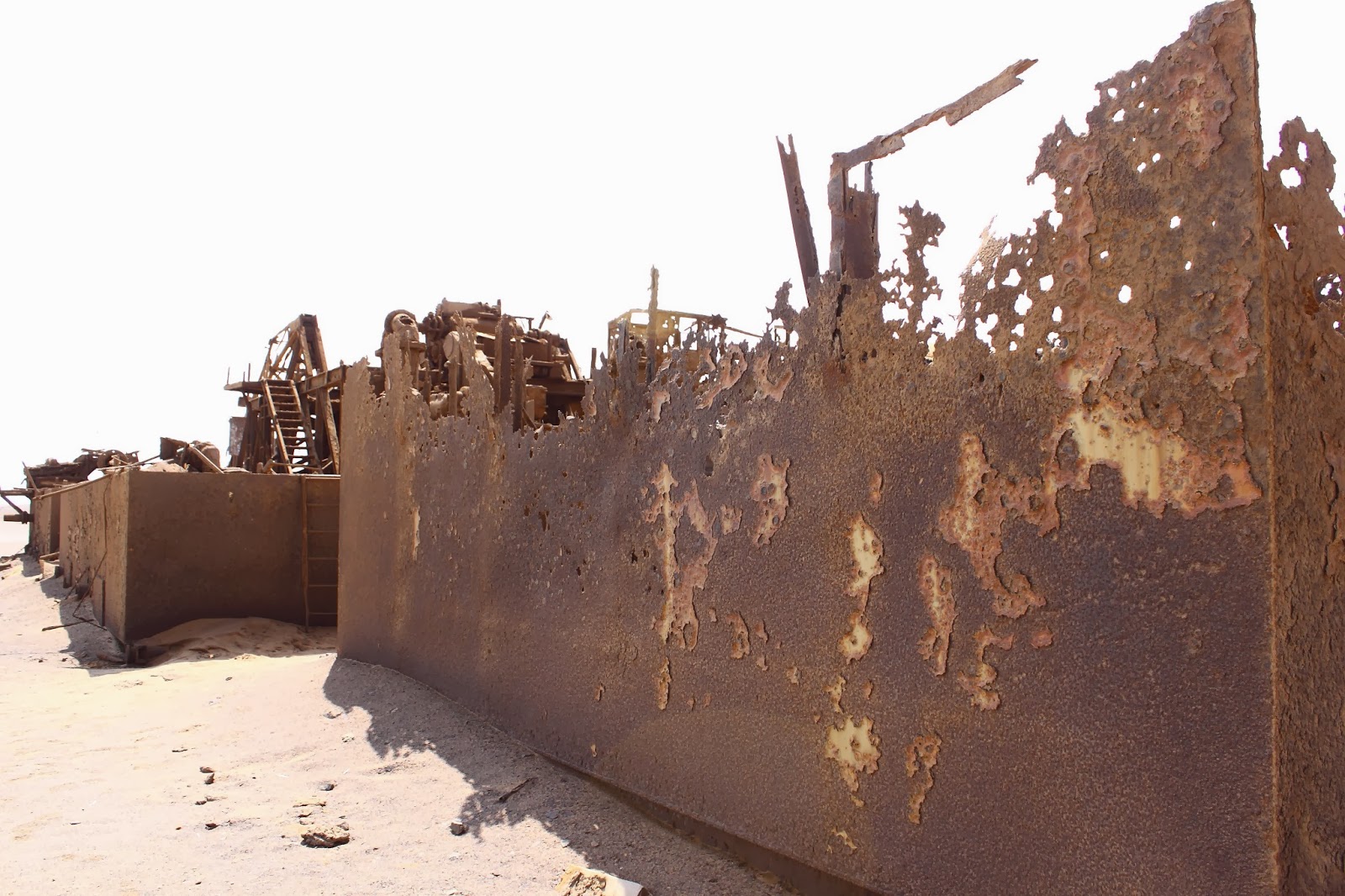
The oil drill rig is so rusted its steel plates look like lace curtain:  eaten away by salt air and wind-driven sand.

The derrick, collapsed and toppled into the sand.  Nearby, hyena and jackal tracks head away into the desert.  Why did they come here?  Where do they go?

Abandoned diamond mine:  Remains of a jetty or pipeline juts out into the sea.  T-shaped pillars.  Cormorants sit drying their wings.  It pollutes the empty vastness of the desert beach. Yet, slowly, the desert and the sea are breaking it down.  Claiming it.  Sand covers it and rust erodes it.  One day, it may all be covered or broken or gone.  


Notes from a Namibian Winter


Damaraland:

Etosha to the Skeleton Coast.

It has been up to 36 degrees Celsius here in Damaraland.  A stark beauty.  The earth has turned from white to red and from the featureless flatness of Ovamboland to the broken red hills and mountains of Damaraland.

Mostly dirt road from Khorixas.  Didn’t deflate the tyres but should have:  was sliding around a bit.  Will deflate them before the long day on the gravel tomorrow.

Looking forward to the sea after a month of being  inland.  Looking forward to the cool after weeks of mid-thirty degree heat.


Wednesday, October 30, 2013

Hustlers and Ropey Boats in the Philippines

A version of this story appeared in the Sunday Times Travel Weekly


As our helpless boat drifted closer to the rocks, the Filipina woman got more panicky.  The more panicky she got the more her American husband ignored her.  Bats the size of cats circled the thick jungle trees on the cliff tops.  My thoughts turned from how to get my backpack and camera from the floundering boat onto the rocks without getting them wet, to how we were going to get the frightened woman and her overweight husband ashore without one of them drowning.  It felt too early in the journey for an adventure.

Meanwhile, the boat-boys had their bottoms in the air and their heads down in the engine housing.  A pin that attached some or other rod to the propeller shaft had sheared and they were trying various makeshift solutions to hold things together until we reached the beach resort.  Nothing seemed to be working. Every time they started the engine the power would be too much for the little bit of wire they’d used to secure the link. 

At every failed effort the woman whimpered, the boatmen cursed and we all wallowed on the swell.  The rocks got closer, much closer.

With the rocks now only about ten metres away I decided to find a dry place to put my money which I kept under the insoles of my boots.  Credit cards were an alien concept to me then and even if I’d had one there are many places in the remoter islands of the archipelago that don’t take them.  I carried some of those as a safety net.

I tried to think where the driest spot would be for my dollars if I had to swim for it.  Then the engine chug-chugged and kept chugging, the boatmen whooped and laughed, full of joy and big smiles.  They’d fixed the problem.  I laced up my boots again.

I had arrived in Manila from Hong Kong the night before and checked into a hotel in the centre of town.  A pleasant change from the budget accommodation I usually used in the scruffy districts of Malati and Ermita.  After dinner I wandered into the nearest bar for a nightcap and some company.  The velvet curtain at the entrance should have been a giveaway.  Inside, a young woman in a lycra outfit was slinking half-heartedly up and down the dimly lit bar-top, occasionally curling herself around the chrome poll before walking back the other way.  She looked bored.  A few middle aged westerners were dotted around the bar, far enough away from each other not to have to engage in conversation.  I conformed and sat at a respectful distance.  After a couple of beers and some attempts by the girls to get me to take them home, I left. Alone.

I arrived at the port the next day looking for the local ferry for Puerto Galera.  Not the fast, expensive tourist boat, but the local banca.  These long, narrow boats with bamboo outriggers and single cylinder engines are the mainstay of inter-island transport.  But to find the right one at a busy port requires either some local knowledge or a knowledgeable local.  I had neither. 

I was quickly surrounded by a small band of men in faded t-shirts and cut-off jeans.  “You want boat to Puerto?”  I said I did and was bustled along towards the quayside.  “You pay now”.  Five of them were pulling and pushing and plucking at my shirt.  “You pay now!”  They said pointing to a boat full of people.

The vagabonds on the quayside had nothing to do with the little boat to Puerto.  They weren’t touts, they were conmen.  A passenger explained that I’d paid five times the fare.  I asked the boatmen how much I owed them but they refused payment, embarrassed that a visitor to their country had been swindled.   It was a reminder of why I was back in those beautiful islands with their warm and generous people.